Lego & cardboard boxes
Updated: Sep 18

Ocado is the UK’s biggest online grocery retailer. As a UX designer working at this technology driven company, we care not only about improving the lives of the customers, but also the employees who work hard to provide them with an excellent service.
In today’s workplace, too often employees have to endure out-dated and cumbersome tools that are frustrating and difficult to use. In this article, you’ll see one example of how we discovered problems faced by our employees and what we did to come up with a solution. I will also share with you some tips you could use in your project.
But first I have a question for you. Do you know what a spoke is?
When I first started working for Ocado, I didn’t either.
Last October I heard the news from our product manager that there were plans to start working on ‘spokes’. Our job was to build the software that they needed to operate the facility.
I was invited for a quick tour around the warehouse where all the groceries for Ocado are prepared for delivery. This is where I learnt that not all orders are delivered directly from there to the customers. The reason is distance.
Ocado delivery drivers work up to 8 hours in each day. During an average shift, the furthest customer they can reach is about 30 miles away. If an unlucky customer lived too far away from the warehouse, it won’t be possible to deliver to them.

A simple solution is to build another warehouse nearer to the customer who lives outside of the delivery zone. But the problem is cost. Ocado warehouses are huge. They have facilities to process goods coming in as well as robots to pick and group items into individual customer orders. This makes them expensive to build and run.

A much cheaper solution is to build a smaller and simpler warehouse that doesn’t have all the facilities of a normal warehouse. We call them spokes. They receive goods from the main warehouses, which are known as hubs. From the spokes orders are delivered to the customers. The more spokes you have, the larger your delivery area.

But here we face a challenge. My team and I didn’t know very much about how spokes worked. It's time for another trip.
Daytrip
Getting out of the office and visiting a spoke is probably the best way to find the answers. So on a cold and grey December day, my team and I visited Ocado’s Enfield spoke, located in the northern outskirts of London.


What we saw was the hard work done by the marshals. They have to stand in the cold, moving heavy and bulky dollies loaded with groceries. There is a constant humming noise coming from the machinery, so ear plugs were a must. To make matters worse, all the dollies they were pushing around look exactly the same! No labels, no difference in shape or colour. How do you know you’re loading the right dolly? Or how do you know it’s facing the right direction? To find that out, the marshal has to scan a barcode sticker on the dolly with a heavy brick-like device.

It seemed that it was easy to make mistakes. The marshals were loading hundreds of dollies every day. For each dolly they loaded, they have to read tiny pieces of text on a screen cluttered with unneeded information.

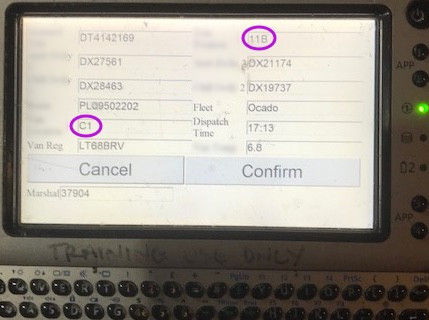
After reading the information, they need to work out whether the dolley needs to be rotated or not. This involves doing complex mental rotation of the dolley in their head, which is a difficult and error prone cognitive task.
Speaking to our guide, I was told that mistakes do happen from time to time. There are two main types of mistakes. The first is an orientation mistake - the dolly is loaded back to front. The second is a position mistake, the dolly is loaded on the wrong side of the van.

You might be wondering why it matters how exactly dollies are placed in the van. The reason is that if a dolly is incorrectly loaded, it will be much more difficult for the driver to find and unload the customer’s order. Drivers have a certain amount of time to do each delivery. Wrongly loaded dollies mean deliveries taking more time than they should as they struggle to find the customer’s containers. The drivers under time pressure feel stressed, while the customers are upset with the late delivery.
There must be a better way of working! But how do we solve it?
Making sense of it all
Before jumping straight into a solution, we need to take some time to make sense of it all. Some of us are very good at visualising things in our heads, but not everyone can do it easily.
One technique that I often use to make sense of something complex is by sketching it out. When sketching we start to create a simple model of the reality we saw, focusing on the essential, discarding the unnecessary distractions.

With the sketch, everything suddenly becomes more clear. It becomes easier to understand the problem we want to solve as well as its context.
But there is a disadvantage to sketches. You can’t move things in it (easily), nor can you rotate the scene to see it from a different angle. It’s difficult to imagine and explore other possibilities — what if we did this, what if we did that; what if this happened, what if that happened. You could sketch out every possibility, but doing this would be tedious and time consuming.
So what about Lego bricks? We don’t have to sketch everything out. Instead of sketching why don’t we build the spoke using Lego?
Lego bricks are perfect for making those boxy looking dollies. We can use blue bricks to make the chilled dollies, and red bricks for the ambient dollies. The little Lego figures can play the role of the marshals. We can also make vans and trailers out of Lego. But a quicker way was to get hold of some cardboard vehicles. For the floorplan, we can draw it on a large sheet of paper, outlining the walls, storage rooms and the parking bays. When we have done all of this, it’ll look something like this:


With the entire spoke now laid out in front of our eyes, we can see things in a more holistic way. (Sorry I cannot show a complete layout due to NDA.) Walking around the model, we can see the operation from different perspectives. We can role play different scenarios simply by moving the Lego figures, dollies and mini vehicles. It’s a lot easier to explore different possibilities than with sketching.
The Lego model is a great communication tool as well. When discussing spokes with other people, the model acts as a shared point of reference. Some things are much easier to explain and understand when you can show people what you mean with physical objects.
But now I’m sorry to bring you some bad news. There is one thing that the Lego model is quite bad at. It doesn’t give you a realistic experience of doing the actual work the staff do. If you want to experience exactly what it’s like to do an individual piece of work, such as loading a van, the Lego model won’t work well. The perspective you get is a bird’s eye view, but to experience a marshal’s task, you need to see it from the marshal’s point of view.
We could pretend to load a Lego dolly into a paper van, but doing this is a vastly different experience to doing the real work. The Lego dolly is 4cm tall and weighs almost nothing, whereas the real dolly is 2 meters tall and weighs about 200kg.

When loading a real dolly, you first need to scan it with a device. Then you need to check which side of the van it needs to go to. All of this can’t be simulated realistically with a Lego model.

To role play van loading more realistically, we needed something bigger!
The obvious solution is to use actual dollies from the spoke, but this is not the easiest or most practical option. Our office is the place where we ideally we want to do the role play. However we don’t have enough space there to keep the number of dollies needed to realistically represent the work at the spoke. Even if there was enough space, we would struggle to fit a dolly through an office door!
We needed something more suited for office use - something small and light enough to be easily moved and stored, yet big enough to act as a substitute dolly.
What about cardboard boxes?
Cardboard boxes have the same cuboid shape as a dolly. But they have the advantage of being light and easy to store. Available to buy in many shapes and sizes, finding something that matched our needs wouldn’t be difficult.

At the spoke, marshalls organise dollies into long queues in the storage room. Because my cardboard boxes were relatively small, I was able to find space in the office to set up something similar.

If you remember from the spoke visit, dollies are not labelled. You have to scan barcodes on them to find out which one they are, and which way they are facing. To replicate this, I attached barcodes to both sides of the cardboard boxes.
What we need next is a barcode scanning app. Something that would allow us to find out where and how to load the dolley. I asked a developer in my team to create such an app.
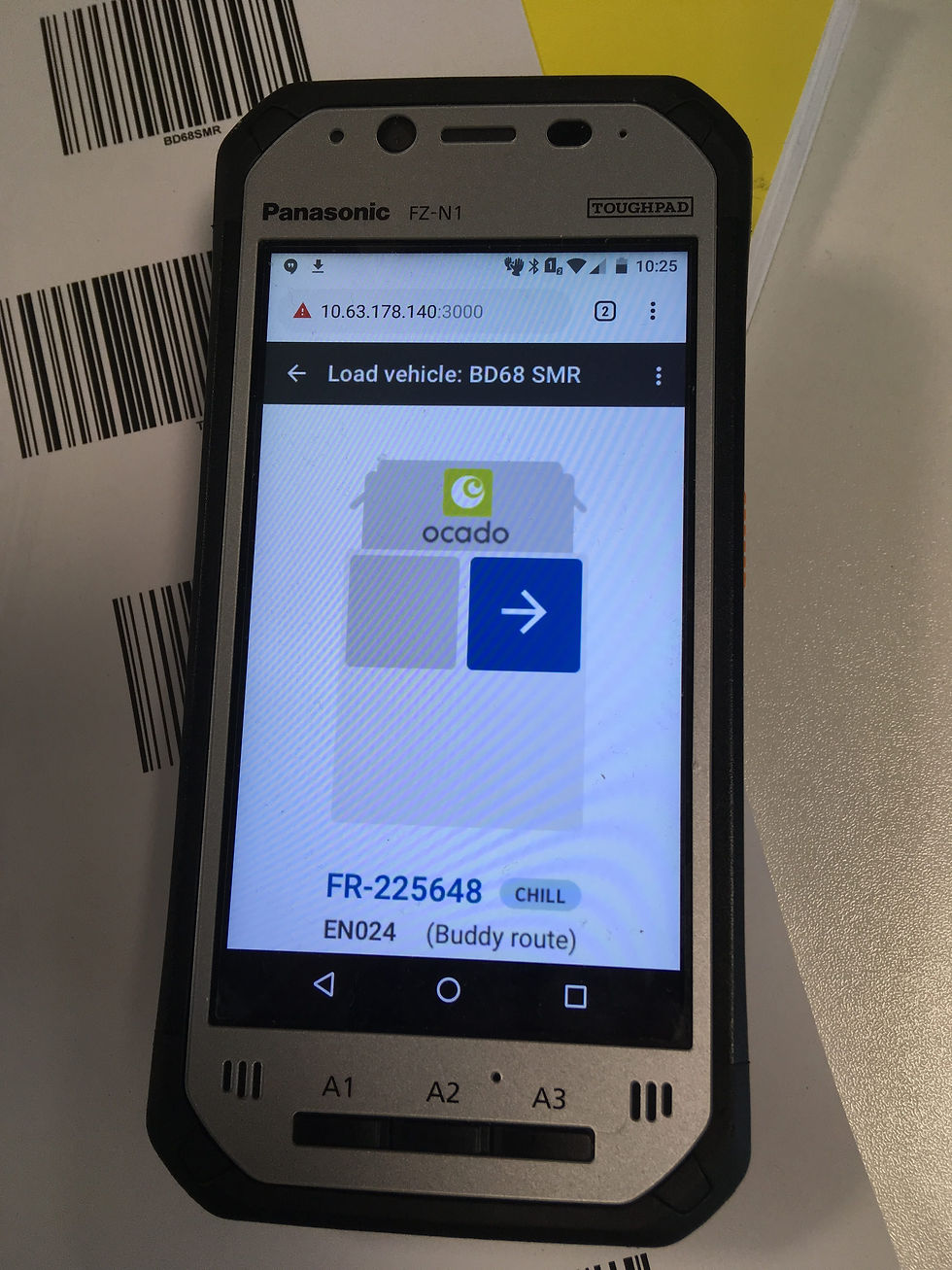
Now we have something we can scan barcodes with just like in the spoke.
But hang on, what do we load the dollies into? Where is the van? For this, why not use chairs?
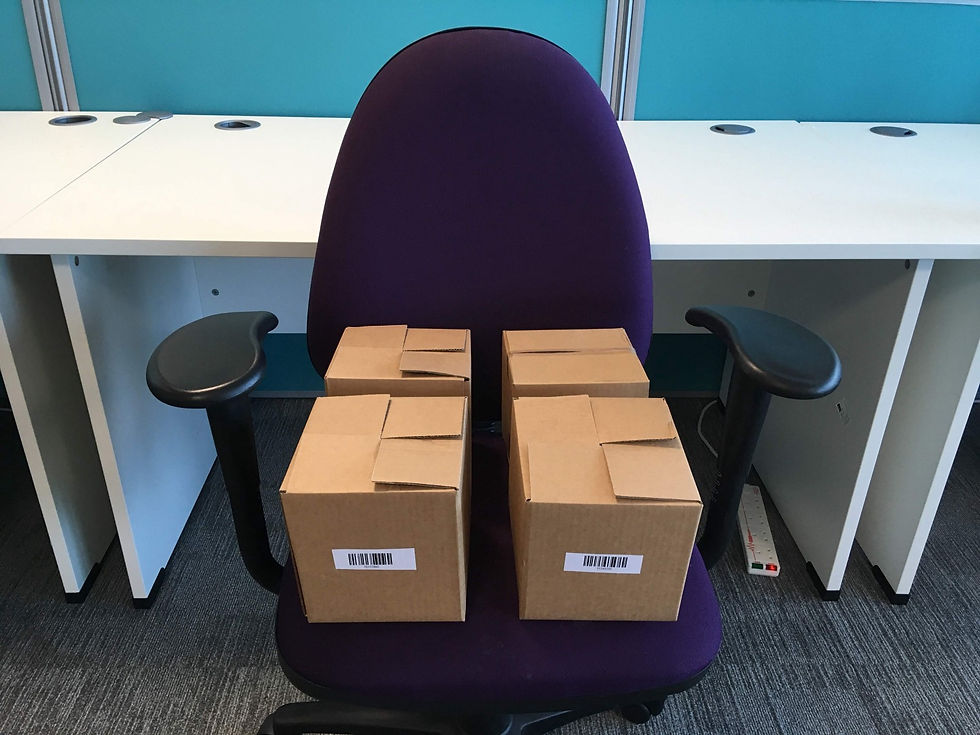
And now, finally, we have everything we need to role play van loading. Let’s grab a barcode scanner and get started!
I recommend first doing the role play yourself, then inviting others to do it too. When you role play the tasks yourself, it puts you in the shoes of the user — you experience what the user experiences. But it’s important to watch others too. We’re all different; we think and understand things differently; what’s easy for one person could be hard for another.
I recruited a few of my colleagues from around the office to try out the van loading. I ran the exercise in a usability test format, giving the participants some instructions, then asked them to think out loud as they carried out the task.

After the role plays I felt enlightened!
My understanding of the problem had dramatically improved. Not only did the role play uncover usability problems with the existing way of van loading, it also helped us see further improvements we could make.
After a few iterations, these were the designs I decided to take forward for refinement and development.

That’s all I have to share with you for now. But before we wrap up, here are some takeaways / tips.
If your users use more than just the UI screen to accomplish their goal, consider Modelling or Role Play.
Modelling or Role Play can improve your understanding of experiences where physical objects or the physical environment plays an important role.
Modelling helps you understand a complex system in a holistic way.
Models are good for understanding high level processes and flows that involve people and objects in a physical environment.
Models can be easily changed or manipulated to explore alternative ways of solving the problem.
A model makes it easier to communicate ideas with people you’re working with.
Role play helps you empathise with the user.
You can recreate the user’s physical environment and the objects they use in your own workspace.
Everyday objects can be substitutes for the actual objects people use. If there isn’t a substitute object, consider making it out of paper, cardboard or plastic containers.
If there are many people/roles involved in the problem you want to understand, have someone play each of the roles.
Recommendation from colleague
This is a linkedin recommendation I received from my colleague, who was a UX designer I worked with on this project.
Steve is a versatile and seasoned designer constantly willing to learn something new. We had a chance to work on some projects and I'll never forget him using Lego bricks for running workshops or conducting user interviews. Steve has strong analytical mind and was doing the best in complex projects involving designing for processes where physical processes intertwined with digital ones. Above all Steve has positive, friendly personality and very collaborative approach. Great asset to any team!
- Łukasz Mikulski / UX Manager at Ocado


